Updating on Geothermal's 2025 Progress (in 2026)
There are enough developments to justify an update after ~18 months. A key theme will be how the business and development paths are diverging for several of the front-runners.
Drilling Continues to Pop
Fervo is the best-known company in the space and a leader in drilling speed. Most other players have also seen significant speed ups.
On-bottom drilling is the part of drilling and fracking that has the most learning curve-like effects. Other activities, such as running casing, tripping pipe, making connections, pumping cement or water, and moving sand, are already close to their physical improvement limits.
Geothermal wells designed like unconventional shale wells should see large initial improvements, then level off as on-bottom drilling becomes a smaller portion of well cost and time. That pattern is visible with Fervo's latest releases
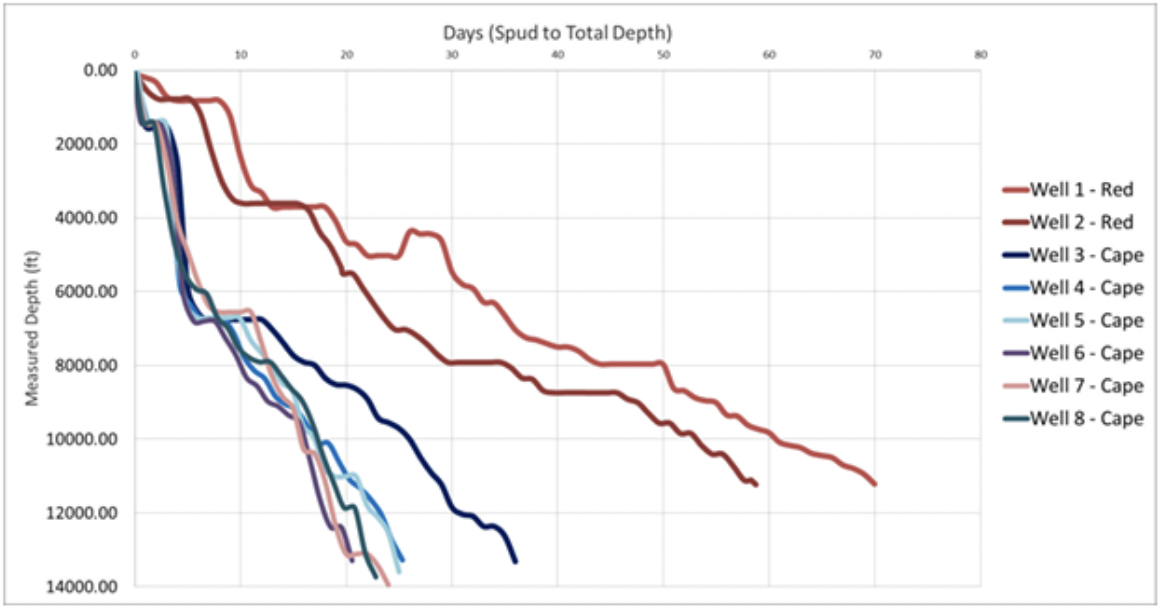
Fervo's Drilling Improvements
Improvements Through Geometry and Temperature
Fervo's technology involves Enhanced Geoethermal (EGS). They fracture rock between two horizontal wells, then pump fluid from one well to the other, collecting heat from the rock in between.
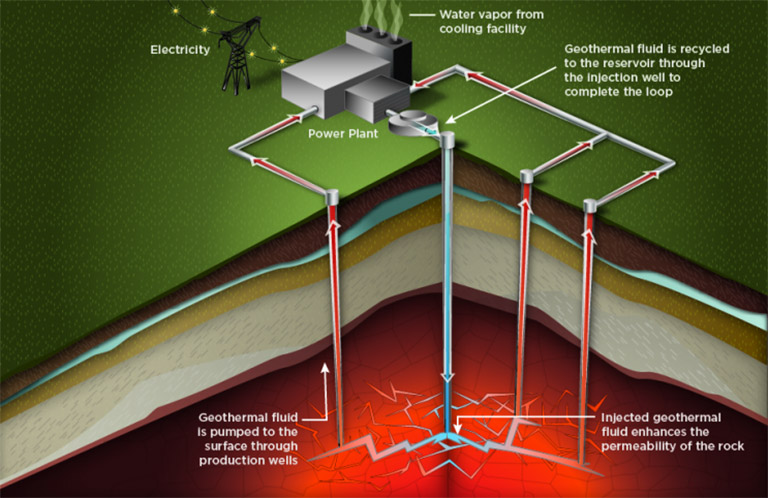
EGS scheme with vertical wells; Source: NREL
Drilling returns might be diminishing, but Fervo (and other Enhanced Geothermal companies) can alter well designs to improve productivity. Deeper, hotter wells increase energy extraction. Longer laterals allow more fluid flow through one well pair and its surface equipment. Increasing the distance between the pairs can increase their rock contact and heat removal rate.
The industry is devoting significant effort to reaching higher reservoir temperatures because not only can a lateral remove more heat from hotter rock, but the higher fluid temperature can produce more electricity per unit of heat. The temperature rating of every drilling and completion component must increase.
The challenge with geometry changes is getting the heat transfer fluid (water) to cooperate. Fervo has already made pretty remarkable progress in distributing fluid along the lateral so it doesn't "short circuit" and preferentially travel through a limited section. There are still some questions on water losses, which were 10%-20% in the Project Red pilot. Making laterals longer and further apart increases the difficulty of distribution and losses, but it is certainly worth trying.
Location Flexibility
One thing that has become apparent is that enhanced geothermal might be "geothermal in a lot more places," but it isn't geothermal anywhere. The footprint is similar to wind turbines in that the locations themselves use small amounts of land, but are spread out over a wider area. There needs to be adequate water supplies. Shallow, high-temperature reserves make a big difference but aren't common. Concentrating on one area is immensely helpful because of similar rock properties and lower costs from items like rig moves. Drilling in the same place generates temporary learning effects and more durable improvements. Most of the logical sites are in the US Intermountain West.
The electricity can get to market through transmission lines, which are always fraught. Alternatively, large loads, such as data centers, can be located near the geothermal power plants.
One issue is that the best locations become predictable. Better technology can easily accrue to leaseholders instead of developers.
The footprint, regulatory restrictions, and geography push enhanced geothermal towards electricity production, especially serving data centers, over heat sales to existing factories or cities.
Location-Specific Geothermal's Revenge?
Zanskar uses modern exploration technology to discover traditional hydrothermal reserves. The company announced several discoveries over the last year. Zanskar's business model is similar to the oil industry, where the goal is to locate previously unknown reserves. It is much more difficult for lease owners to extract rents. The question is how many undiscovered, viable reserves still exist. The technology to find large pockets has existed for a long time, and the remaining finds will be smaller features. The finds could easily be enough to make a company valuable, but not matter much for the wider energy supply.
Mazama, which focuses on high-temperature systems (think volcanoes), announced a successful pilot project.
Both of these companies are betting that extending traditional techniques can provide a relatively inexpensive marginal supply. A further bet is that data centers can buy the power if the site is in the middle of nowhere. The uncertainty on both the supply and demand sides makes this area somewhat of a wild card going forward.
Europe and Closed Loop
I've been bullish on a specific type of closed-loop geothermal that is like an underground radiator. It does not require completions, cement, or casing in the laterals. The "service footprint," or number and sophistication of vendors required, is a fraction of enhanced geothermal. Drilling at high temperatures requires less new technology and is solved using chilled drilling fluid and insulated drill pipe to keep the drilling tools cool. Operating costs are also very low. Closed-loop is the most flexible in siting, making leasing costs less of an issue, and opens up a wide range of potential customers. The lack of fracturing prevents many regulatory issues.
The catch is that it requires many times more drilled footage because of worse heat transfer performance than enhanced geothermal. That makes it a very "bitter lesson"-style technology since the cost is almost purely on-bottom drilling, which tends to improve the fastest.
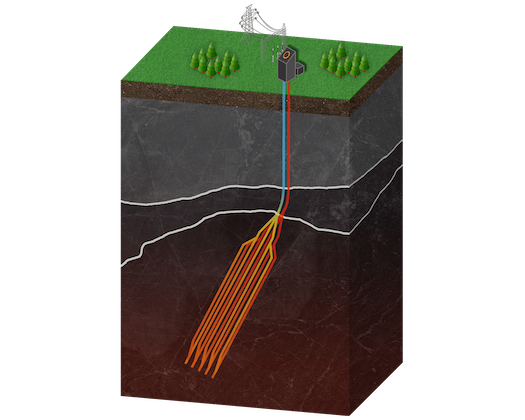
Eavor's Radiator Concept
Eavor is the main company pursuing this path and was struggling with drilling execution at the time of the last update. The first project in Germany is now operational, providing combined heat and power to local towns. The company also replaced the CEO.
The company claims to be competitive in providing low-grade heat (especially district heating) in Europe, and my napkin math agrees. The numbers from company statements suggest the levelized cost of heat could be $25-$40/MWh, or similar to European natural gas prices. The cost might be 20% lower with American drilling performance levels.
Electricity is out of reach because the power plant is expensive, and the efficiency is ~12%. Again, the best way to alter that math is for Eavor to catch up on drilling execution and go for hotter rock.
Now comes the point where the simplistic spreadsheet model gets tested to see if the technology can truly scale. Converting European district heating to Eavor loops requires several hundred rig-years' worth of drilling. The technology will be a minor player unless the number of rigs drilling closed-loop wells quickly rises into the double digits (~$1 billion/year in CAPEX).
Eavor is not pursuing project development. The company must sign up partners with capital and drilling execution ability if it wants to grow.
Pushing Closed Loop
Closed-loop could be even simpler. Eavor's multi-lateral wells are difficult, but they help increase footage in the horizontal section relative to the vertical wellbores that reach up to the surface and don't contribute any heat.
But what if multiple laterals aren't necessary? The longest shale well laterals are now ~5 miles long. A lateral that long minimizes the relative cost of the vertical section. A single lateral eliminates sidetracks and whipstocks, limits fluid paths, and retires most mechanical risk. It reduces the number of connections between laterals that need to be made or possibly eliminates them if fluid returns in insulated tubing.
Another point is that Eavor has not yet operated a full loop in granite, only in sedimentary rock. Its "rock seal" product reduces the permeability of the bare rock, but it might not be necessary in tight granite. Lighter circulating fluid (fresh water) and traditional lost circulation materials are likely enough to prevent significant leaks.
The closed-loop architecture can become easier to execute.
Conclusion
Eighteen months ago, the relevant projects were starting construction. The industry executed well enough to get a shot at true commercial-scale deployments. Eavor is financeable in the European heat market, and Fervo plans to IPO soon. The results over the next few years will determine if this wave is a flash in the pan or if it can lead to the previous success metric of "10% of electricity generation."
The question becomes where geothermal's "great filter" is. It's likely ahead in project economics and scalability. New energy technologies can often build the first version, but the 2nd or 10th is much more challenging. Nonetheless, the leading companies not dying is still a feat. The marathon to relevance continues.
2026 Geothermal Update
2026 February 22 Twitter Substack See all postsProgress grinds forward as the great filter looms.
Updating on Geothermal's 2025 Progress (in 2026)
There are enough developments to justify an update after ~18 months. A key theme will be how the business and development paths are diverging for several of the front-runners.
Drilling Continues to Pop
Fervo is the best-known company in the space and a leader in drilling speed. Most other players have also seen significant speed ups.
On-bottom drilling is the part of drilling and fracking that has the most learning curve-like effects. Other activities, such as running casing, tripping pipe, making connections, pumping cement or water, and moving sand, are already close to their physical improvement limits.
Geothermal wells designed like unconventional shale wells should see large initial improvements, then level off as on-bottom drilling becomes a smaller portion of well cost and time. That pattern is visible with Fervo's latest releases
Fervo's Drilling Improvements
Improvements Through Geometry and Temperature
Fervo's technology involves Enhanced Geoethermal (EGS). They fracture rock between two horizontal wells, then pump fluid from one well to the other, collecting heat from the rock in between.
EGS scheme with vertical wells; Source: NREL
Drilling returns might be diminishing, but Fervo (and other Enhanced Geothermal companies) can alter well designs to improve productivity. Deeper, hotter wells increase energy extraction. Longer laterals allow more fluid flow through one well pair and its surface equipment. Increasing the distance between the pairs can increase their rock contact and heat removal rate.
The industry is devoting significant effort to reaching higher reservoir temperatures because not only can a lateral remove more heat from hotter rock, but the higher fluid temperature can produce more electricity per unit of heat. The temperature rating of every drilling and completion component must increase.
The challenge with geometry changes is getting the heat transfer fluid (water) to cooperate. Fervo has already made pretty remarkable progress in distributing fluid along the lateral so it doesn't "short circuit" and preferentially travel through a limited section. There are still some questions on water losses, which were 10%-20% in the Project Red pilot. Making laterals longer and further apart increases the difficulty of distribution and losses, but it is certainly worth trying.
Location Flexibility
One thing that has become apparent is that enhanced geothermal might be "geothermal in a lot more places," but it isn't geothermal anywhere. The footprint is similar to wind turbines in that the locations themselves use small amounts of land, but are spread out over a wider area. There needs to be adequate water supplies. Shallow, high-temperature reserves make a big difference but aren't common. Concentrating on one area is immensely helpful because of similar rock properties and lower costs from items like rig moves. Drilling in the same place generates temporary learning effects and more durable improvements. Most of the logical sites are in the US Intermountain West.
The electricity can get to market through transmission lines, which are always fraught. Alternatively, large loads, such as data centers, can be located near the geothermal power plants.
One issue is that the best locations become predictable. Better technology can easily accrue to leaseholders instead of developers.
The footprint, regulatory restrictions, and geography push enhanced geothermal towards electricity production, especially serving data centers, over heat sales to existing factories or cities.
Location-Specific Geothermal's Revenge?
Zanskar uses modern exploration technology to discover traditional hydrothermal reserves. The company announced several discoveries over the last year. Zanskar's business model is similar to the oil industry, where the goal is to locate previously unknown reserves. It is much more difficult for lease owners to extract rents. The question is how many undiscovered, viable reserves still exist. The technology to find large pockets has existed for a long time, and the remaining finds will be smaller features. The finds could easily be enough to make a company valuable, but not matter much for the wider energy supply.
Mazama, which focuses on high-temperature systems (think volcanoes), announced a successful pilot project.
Both of these companies are betting that extending traditional techniques can provide a relatively inexpensive marginal supply. A further bet is that data centers can buy the power if the site is in the middle of nowhere. The uncertainty on both the supply and demand sides makes this area somewhat of a wild card going forward.
Europe and Closed Loop
I've been bullish on a specific type of closed-loop geothermal that is like an underground radiator. It does not require completions, cement, or casing in the laterals. The "service footprint," or number and sophistication of vendors required, is a fraction of enhanced geothermal. Drilling at high temperatures requires less new technology and is solved using chilled drilling fluid and insulated drill pipe to keep the drilling tools cool. Operating costs are also very low. Closed-loop is the most flexible in siting, making leasing costs less of an issue, and opens up a wide range of potential customers. The lack of fracturing prevents many regulatory issues.
The catch is that it requires many times more drilled footage because of worse heat transfer performance than enhanced geothermal. That makes it a very "bitter lesson"-style technology since the cost is almost purely on-bottom drilling, which tends to improve the fastest.
Eavor's Radiator Concept
Eavor is the main company pursuing this path and was struggling with drilling execution at the time of the last update. The first project in Germany is now operational, providing combined heat and power to local towns. The company also replaced the CEO.
The company claims to be competitive in providing low-grade heat (especially district heating) in Europe, and my napkin math agrees. The numbers from company statements suggest the levelized cost of heat could be $25-$40/MWh, or similar to European natural gas prices. The cost might be 20% lower with American drilling performance levels.
Electricity is out of reach because the power plant is expensive, and the efficiency is ~12%. Again, the best way to alter that math is for Eavor to catch up on drilling execution and go for hotter rock.
Now comes the point where the simplistic spreadsheet model gets tested to see if the technology can truly scale. Converting European district heating to Eavor loops requires several hundred rig-years' worth of drilling. The technology will be a minor player unless the number of rigs drilling closed-loop wells quickly rises into the double digits (~$1 billion/year in CAPEX).
Eavor is not pursuing project development. The company must sign up partners with capital and drilling execution ability if it wants to grow.
Pushing Closed Loop
Closed-loop could be even simpler. Eavor's multi-lateral wells are difficult, but they help increase footage in the horizontal section relative to the vertical wellbores that reach up to the surface and don't contribute any heat.
But what if multiple laterals aren't necessary? The longest shale well laterals are now ~5 miles long. A lateral that long minimizes the relative cost of the vertical section. A single lateral eliminates sidetracks and whipstocks, limits fluid paths, and retires most mechanical risk. It reduces the number of connections between laterals that need to be made or possibly eliminates them if fluid returns in insulated tubing.
Another point is that Eavor has not yet operated a full loop in granite, only in sedimentary rock. Its "rock seal" product reduces the permeability of the bare rock, but it might not be necessary in tight granite. Lighter circulating fluid (fresh water) and traditional lost circulation materials are likely enough to prevent significant leaks.
The closed-loop architecture can become easier to execute.
Conclusion
Eighteen months ago, the relevant projects were starting construction. The industry executed well enough to get a shot at true commercial-scale deployments. Eavor is financeable in the European heat market, and Fervo plans to IPO soon. The results over the next few years will determine if this wave is a flash in the pan or if it can lead to the previous success metric of "10% of electricity generation."
The question becomes where geothermal's "great filter" is. It's likely ahead in project economics and scalability. New energy technologies can often build the first version, but the 2nd or 10th is much more challenging. Nonetheless, the leading companies not dying is still a feat. The marathon to relevance continues.