Enter Cybercab
Tesla had a Cybercab launch party recently and opened Cybercab rides to the public in Austin, Texas. The vehicle is a beautiful piece of engineering and is one of the gutsiest technology bets in recent memory. Below is an ode to the vehicle and how it will change our world.
The Bet
Car companies typically expand by adding more models to address different market segments. Normal vehicles need to fill a wide variety of roles for one owner while also having acceptable style and status. Hence the number of models proliferates because each one addresses a different slice of the market.
Most analysts and industry watchers expected Tesla to do the same after its successes with a sedan (Model 3) and a crossover SUV (Model Y). Instead, Tesla cancelled a raft of vehicle concepts, released an unusual one in the Cybertruck, and stopped production of Model X and Model S. The lack of new models made sales flat, leading to a lot of questions.
The Cybercab, a dedicated two-seat robotaxi platform with no steering wheel or pedals, consumed a big chunk of the car division's engineering and design resources instead.
The demand curve for "trips" has a very steep initial fall where there are a number of small trips worth paying a lot for. They might remove the need for a rental car when traveling or get you home safely from the bar. The curve then quickly levels off into a long tail of trips that represent a family's third car, a trip where parking is slightly inconvenient, or a senior that might be willing to give up their keys a few years earlier than planned. The price per mile needs to handily beat owned vehicles to capture these "down the curve" use cases and that takes some extreme engineering.
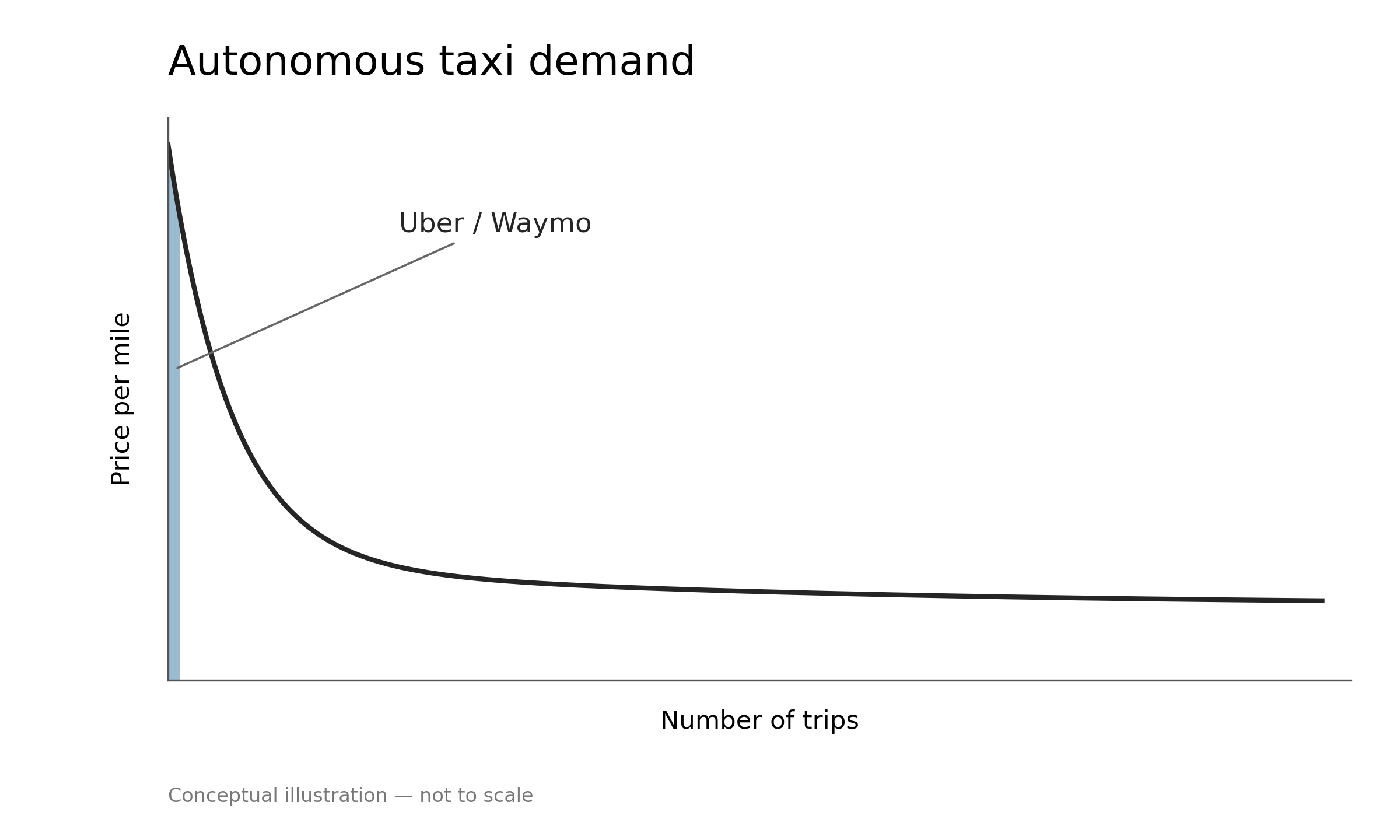
Riding the curve. Created by Astra.
A robotaxi is serving individual trips rather than a long list of owner requirements. The design can focus on maximizing the number of trips it can profitably do rather than handling edge cases. That market is significantly larger than any owned car model.
Cybercab is fundamentally a bet that pouring scarce engineering resources into a near perfectly optimized autonomous taxi platform will earn more than classic model differentiation if that engineering effort can break through cost and scale barriers.
Engineering for Maximum Scale and Minimum Cost
Designing and manufacturing an ultra-cheap taxi requires ruthless optimization using very creative engineering. The first step is deletion.
Setting the Requirements
The focus on trips over edge cases leads to several early requirements:
-
Two Seats
Almost 90% of trips in the US are one or two people. Extra seating adds cost in both size and energy usage, plus Tesla already has larger vehicles that can serve as pricier robotaxis for larger groups. Limiting the car to two seats is an easy tradeoff.
-
Bare Interior
Interior finishes and features can be expensive and are prone to breaking or soiling. The Cybercab has comfortable, reclining seats, a large screen and that is essentially it. The only button not on the screen module is a door release. There are also no back windows, instrument panel, steering wheel, side mirrors, rear view mirrors, or pedals.
-
Moderate Performance
People usually prefer smooth taxi rides and that is helpful since the powertrain can focus on efficiency to the exclusion of the performance other Tesla vehicles have.
-
DC-only Charging
Vehicles will only be charging at set locations with DC chargers, so no need for onboard AC charging that can handle wall plugs.
Removing Manufacturing Bottlenecks
Cybercab is one of the first true electric cars. Even Tesla's Model 3 and Model Y still have vestigial components like extensive CAN bus wiring harnesses, 12V lead-acid batteries, mechanically linked steering wheels, and hydraulic braking systems. Tesla's Cybertruck served as the derisking platform to eliminate or replace nearly all of these subsystems with electrically native versions. Cybercab completes the transition. The reason to make these changes is that the new systems are easier to control digitally, are lighter/cheaper, and easier to install:
-
Elimination of Cross Car Wiring
In traditional cars every button or device has wires running back to the central CAN bus controller. That includes lights, door locks, window controls, radios, etc. All these cables are put in complex, unwieldy wiring harnesses that are one of the most difficult jobs in assembly and notoriously impossible to automate since they are fragile and floppy.
Tesla replaced about 70% of this wiring in Cybertruck with modern zonal controllers so each component's wires only run a few inches to the closest controller. The system operates more like a modern network over Ethernet instead of like a device from the 1980s. The reduction in wiring is extreme and the new assemblies are easier to install. Cybercab likely gets close to 100% removal as the next iteration and because many parts, like a side mirror adjustment, don't exist in Cybercab.
-
48 Volt Power System
Cars have had 12V power systems for over 70 years. The voltage limits what loads can be on the electrical system without very thick wiring. Tesla switched to a 48V architecture on Cybertruck and then Cybercab.
-
Electrically Actuated Brakes and Steering
The 48V system allows for small electric motors to easily move the wheels and brake calipers instead of using hydraulics or mechanical linkages. Steering columns and brake hydraulic systems can be complicating and again are systems that span large portions of the car, making assembly challenging.
Modularizing Car Manufacturing
Ever since the Ford Model T, cars have been assembled starting with the entire frame. They had to be when wiring harnesses, drive shafts, and brake lines ran the length of the car. Fully digital and electric cars eliminate these car-spanning items, opening up new assembly paradigms.
Tesla is moving away from full-body assembly with Cybercab, calling the new process "unboxed." The car is broken into four or five modules that only come together at the end of assembly. That makes it easier to access modules and makes assembly more parallel. These changes significantly shorten the cycle time for assembly of Cybercab. Tesla's goal is a car being produced every 10 seconds instead of 40-90 seconds for typical car production lines.
The significance of cycle time is that it determines the production rate per assembly line. A 10-second cycle time line produces 6 cars per minute, 360 per hour, 8640 per day, and 3,153,600 cars per year. Of course, uptime won't be 100%, so on the order of 2.5 million cars per year would be a realistic capacity. Toyota produces the most cars of any automaker at 11 million cars per year across 100+ models. The highest-output non-Tesla production lines produce 400,000 cars per year. 2.5 million Cybercabs per year from one line is grossly oversized for the traditional auto market, but not for robotaxis. The Cybercab line is also half the length/stations of a normal car line, making it roughly an order of magnitude more space and assembly labor efficient.
There are a few more unlocks needed to hit this speed:
-
Cheap, Efficient, Rare-Earth-Free Motors
Tesla's engineers figured out how to make a motor as efficient as a fancy rare earth material permanent magnet motor with only refrigerator magnets (made of iron). And the motor/drive unit can be produced within the ten-second cycle time paradigm.
-
Eliminating the Paint Shop
Painting cars has become an enormous pain. The paint shops are expensive, trigger all sorts of environmental thresholds, and they complicate production. Usually doors have to be put on the car, painted, taken off for assembly, then put back on at the end. Painting really has to go.
Tesla tried a stainless steel exoskeleton with Cybertruck, but that ended up being challenging. The Cybercab has injection-molded plastic body panels instead of typical painted sheet metal. Cars have had plastic body panels before, but the panels didn't come out with a good finish or color, requiring painting. Tesla's "Reactive Injection Molding" parts do come with a smooth finish and with color incorporated so the paint shop can finally disappear, greatly simplifying production.
-
Gigacasting
Most cars are made of small pieces of sheet metal welded into a body by hundreds of robot welders. Starting with the Model Y, Tesla uses "gigacasting" for most of the body structure, replacing over 70 parts with one.
The end result is a manufacturing system that will be more productive than any previous car program and a robotaxi that costs $20,000 to produce instead of a Waymo that costs >$100,000.
Advancing Driving Software
Tesla's software and self-driving hardware strategy mirrors the rest of the car - use a simple architecture that can be inexpensive and scalable. Somewhat controversially, the system relies on cameras only for sensing and a power-sipping custom processing unit that is much more specialized than GPUs used in most other self-driving car programs. The software architecture has gone through dozens of rewrites over the years and the current iteration is an end-to-end trained neural net.
The driving software's progress was mixed over ten plus years of development. Turnover for the top driving software job was high early on. Tesla, like most others in the space, used a lot of deterministic code that looks good in demos but becomes brittle in deployment because of edge cases. The biggest shift came around the time Andrej Karpathy joined in 2017 along with the elevation of today's software leader, Ashok Elluswamy. The strategy became to have neural nets replace all the deterministic code in the software stack.
Progress was slow until December 2024 when Tesla shipped a true end-to-end neural net. Like other modern architectures, the end-to-end neural net is built to improve through the brute force of scaling laws. Tesla's first large, modern data center for vehicle training came online around the same time, along with cars shipping with "Hardware 4" that is designed to run the end-to-end software stack better than previous hardware.
Progress has been much faster after these segments aligned. Within one year the software went from barely being able to do one neighborhood trip without driver intervention to being capable of cross-country drives with zero disengagements. Tesla plans to continue refining its data, optimizing the software stack, training with more compute, and improving the in-car hardware.
As of September 2026 there are hundreds of driverless Tesla ride share vehicles operating in markets like Austin, Texas, including dozens of early production Cybercabs.
Minimizing Operating Costs
Tesla designed the Cybercab to be ridiculously low maintenance and efficient.
There is very little to break with so many systems removed and most components designed to last a million miles. Regular maintenance tasks are limited to things like changing tires, adding wiper fluid, and replacing wiper blades. Even items like brakes will last way longer than with a human driver since the software can maximize regenerative braking and minimize friction braking.
The car is small and aerodynamic with very efficient motors, allowing it to get 6 miles per kilowatt-hour. That is 204 miles per gallon equivalent.
These items plus the inexpensive upfront cost and long life add up to a very low cost per mile to operate. Tesla's long-term goal is $0.20 per mile, well below the IRS's current $0.76 per mile rate.
Estimating the Impact
The focus on scale and cost means the Cybercab can be more than a novelty. And that is what matters when there are over a million deaths globally and tens of millions of injuries from car accidents each year.
Waymo has something like 4000 vehicles deployed and could add a few thousand more by the end of 2026. That is 2-3 weeks of the still ramping proto-line that will produce 125,000 Cybercabs per year.
Chat estimates ride share companies service 10 million trips per day just in the US. A Waymo gets around 20 trips per day and at higher density could possibly do 30 trips per day, requiring 330,000 to 500,000 autonomous vehicles to satisfy current ride share demand. It would take a few months for a full rate, ~2,500,000 vehicles per year Cybercab production line to meet that demand.
Ride share is only 1% of trips in the US. Waymo's talk of tens of thousands of vehicles per year is a rounding error in market share. Tesla's Cybercab design and production system give it a chance to be relevant by eventually adding 8-10 production lines to transition the world to autonomous vehicles in a reasonable amount of time.
There are still many regulatory and finance hurdles to overcome, but the fundamentals are in place.
So ends the ode to Cybercab.
Disclosure: Long TSLA
An Ode to Tesla's Cybercab
2026 September 27 Twitter Substack See all postsThe bet to deliver autonomous vehicles to the masses.
Enter Cybercab
Tesla had a Cybercab launch party recently and opened Cybercab rides to the public in Austin, Texas. The vehicle is a beautiful piece of engineering and is one of the gutsiest technology bets in recent memory. Below is an ode to the vehicle and how it will change our world.
The Bet
Car companies typically expand by adding more models to address different market segments. Normal vehicles need to fill a wide variety of roles for one owner while also having acceptable style and status. Hence the number of models proliferates because each one addresses a different slice of the market.
Most analysts and industry watchers expected Tesla to do the same after its successes with a sedan (Model 3) and a crossover SUV (Model Y). Instead, Tesla cancelled a raft of vehicle concepts, released an unusual one in the Cybertruck, and stopped production of Model X and Model S. The lack of new models made sales flat, leading to a lot of questions.
The Cybercab, a dedicated two-seat robotaxi platform with no steering wheel or pedals, consumed a big chunk of the car division's engineering and design resources instead.
The demand curve for "trips" has a very steep initial fall where there are a number of small trips worth paying a lot for. They might remove the need for a rental car when traveling or get you home safely from the bar. The curve then quickly levels off into a long tail of trips that represent a family's third car, a trip where parking is slightly inconvenient, or a senior that might be willing to give up their keys a few years earlier than planned. The price per mile needs to handily beat owned vehicles to capture these "down the curve" use cases and that takes some extreme engineering.
Riding the curve. Created by Astra.
A robotaxi is serving individual trips rather than a long list of owner requirements. The design can focus on maximizing the number of trips it can profitably do rather than handling edge cases. That market is significantly larger than any owned car model.
Cybercab is fundamentally a bet that pouring scarce engineering resources into a near perfectly optimized autonomous taxi platform will earn more than classic model differentiation if that engineering effort can break through cost and scale barriers.
Engineering for Maximum Scale and Minimum Cost
Designing and manufacturing an ultra-cheap taxi requires ruthless optimization using very creative engineering. The first step is deletion.
Setting the Requirements
The focus on trips over edge cases leads to several early requirements:
Two Seats
Almost 90% of trips in the US are one or two people. Extra seating adds cost in both size and energy usage, plus Tesla already has larger vehicles that can serve as pricier robotaxis for larger groups. Limiting the car to two seats is an easy tradeoff.
Bare Interior
Interior finishes and features can be expensive and are prone to breaking or soiling. The Cybercab has comfortable, reclining seats, a large screen and that is essentially it. The only button not on the screen module is a door release. There are also no back windows, instrument panel, steering wheel, side mirrors, rear view mirrors, or pedals.
Moderate Performance
People usually prefer smooth taxi rides and that is helpful since the powertrain can focus on efficiency to the exclusion of the performance other Tesla vehicles have.
DC-only Charging
Vehicles will only be charging at set locations with DC chargers, so no need for onboard AC charging that can handle wall plugs.
Removing Manufacturing Bottlenecks
Cybercab is one of the first true electric cars. Even Tesla's Model 3 and Model Y still have vestigial components like extensive CAN bus wiring harnesses, 12V lead-acid batteries, mechanically linked steering wheels, and hydraulic braking systems. Tesla's Cybertruck served as the derisking platform to eliminate or replace nearly all of these subsystems with electrically native versions. Cybercab completes the transition. The reason to make these changes is that the new systems are easier to control digitally, are lighter/cheaper, and easier to install:
Elimination of Cross Car Wiring
In traditional cars every button or device has wires running back to the central CAN bus controller. That includes lights, door locks, window controls, radios, etc. All these cables are put in complex, unwieldy wiring harnesses that are one of the most difficult jobs in assembly and notoriously impossible to automate since they are fragile and floppy.
Tesla replaced about 70% of this wiring in Cybertruck with modern zonal controllers so each component's wires only run a few inches to the closest controller. The system operates more like a modern network over Ethernet instead of like a device from the 1980s. The reduction in wiring is extreme and the new assemblies are easier to install. Cybercab likely gets close to 100% removal as the next iteration and because many parts, like a side mirror adjustment, don't exist in Cybercab.
48 Volt Power System
Cars have had 12V power systems for over 70 years. The voltage limits what loads can be on the electrical system without very thick wiring. Tesla switched to a 48V architecture on Cybertruck and then Cybercab.
Electrically Actuated Brakes and Steering
The 48V system allows for small electric motors to easily move the wheels and brake calipers instead of using hydraulics or mechanical linkages. Steering columns and brake hydraulic systems can be complicating and again are systems that span large portions of the car, making assembly challenging.
Modularizing Car Manufacturing
Ever since the Ford Model T, cars have been assembled starting with the entire frame. They had to be when wiring harnesses, drive shafts, and brake lines ran the length of the car. Fully digital and electric cars eliminate these car-spanning items, opening up new assembly paradigms.
Tesla is moving away from full-body assembly with Cybercab, calling the new process "unboxed." The car is broken into four or five modules that only come together at the end of assembly. That makes it easier to access modules and makes assembly more parallel. These changes significantly shorten the cycle time for assembly of Cybercab. Tesla's goal is a car being produced every 10 seconds instead of 40-90 seconds for typical car production lines.
The significance of cycle time is that it determines the production rate per assembly line. A 10-second cycle time line produces 6 cars per minute, 360 per hour, 8640 per day, and 3,153,600 cars per year. Of course, uptime won't be 100%, so on the order of 2.5 million cars per year would be a realistic capacity. Toyota produces the most cars of any automaker at 11 million cars per year across 100+ models. The highest-output non-Tesla production lines produce 400,000 cars per year. 2.5 million Cybercabs per year from one line is grossly oversized for the traditional auto market, but not for robotaxis. The Cybercab line is also half the length/stations of a normal car line, making it roughly an order of magnitude more space and assembly labor efficient.
There are a few more unlocks needed to hit this speed:
Cheap, Efficient, Rare-Earth-Free Motors
Tesla's engineers figured out how to make a motor as efficient as a fancy rare earth material permanent magnet motor with only refrigerator magnets (made of iron). And the motor/drive unit can be produced within the ten-second cycle time paradigm.
Eliminating the Paint Shop
Painting cars has become an enormous pain. The paint shops are expensive, trigger all sorts of environmental thresholds, and they complicate production. Usually doors have to be put on the car, painted, taken off for assembly, then put back on at the end. Painting really has to go.
Tesla tried a stainless steel exoskeleton with Cybertruck, but that ended up being challenging. The Cybercab has injection-molded plastic body panels instead of typical painted sheet metal. Cars have had plastic body panels before, but the panels didn't come out with a good finish or color, requiring painting. Tesla's "Reactive Injection Molding" parts do come with a smooth finish and with color incorporated so the paint shop can finally disappear, greatly simplifying production.
Gigacasting
Most cars are made of small pieces of sheet metal welded into a body by hundreds of robot welders. Starting with the Model Y, Tesla uses "gigacasting" for most of the body structure, replacing over 70 parts with one.
The end result is a manufacturing system that will be more productive than any previous car program and a robotaxi that costs $20,000 to produce instead of a Waymo that costs >$100,000.
Advancing Driving Software
Tesla's software and self-driving hardware strategy mirrors the rest of the car - use a simple architecture that can be inexpensive and scalable. Somewhat controversially, the system relies on cameras only for sensing and a power-sipping custom processing unit that is much more specialized than GPUs used in most other self-driving car programs. The software architecture has gone through dozens of rewrites over the years and the current iteration is an end-to-end trained neural net.
The driving software's progress was mixed over ten plus years of development. Turnover for the top driving software job was high early on. Tesla, like most others in the space, used a lot of deterministic code that looks good in demos but becomes brittle in deployment because of edge cases. The biggest shift came around the time Andrej Karpathy joined in 2017 along with the elevation of today's software leader, Ashok Elluswamy. The strategy became to have neural nets replace all the deterministic code in the software stack.
Progress was slow until December 2024 when Tesla shipped a true end-to-end neural net. Like other modern architectures, the end-to-end neural net is built to improve through the brute force of scaling laws. Tesla's first large, modern data center for vehicle training came online around the same time, along with cars shipping with "Hardware 4" that is designed to run the end-to-end software stack better than previous hardware.
Progress has been much faster after these segments aligned. Within one year the software went from barely being able to do one neighborhood trip without driver intervention to being capable of cross-country drives with zero disengagements. Tesla plans to continue refining its data, optimizing the software stack, training with more compute, and improving the in-car hardware.
As of September 2026 there are hundreds of driverless Tesla ride share vehicles operating in markets like Austin, Texas, including dozens of early production Cybercabs.
Minimizing Operating Costs
Tesla designed the Cybercab to be ridiculously low maintenance and efficient.
There is very little to break with so many systems removed and most components designed to last a million miles. Regular maintenance tasks are limited to things like changing tires, adding wiper fluid, and replacing wiper blades. Even items like brakes will last way longer than with a human driver since the software can maximize regenerative braking and minimize friction braking.
The car is small and aerodynamic with very efficient motors, allowing it to get 6 miles per kilowatt-hour. That is 204 miles per gallon equivalent.
These items plus the inexpensive upfront cost and long life add up to a very low cost per mile to operate. Tesla's long-term goal is $0.20 per mile, well below the IRS's current $0.76 per mile rate.
Estimating the Impact
The focus on scale and cost means the Cybercab can be more than a novelty. And that is what matters when there are over a million deaths globally and tens of millions of injuries from car accidents each year.
Waymo has something like 4000 vehicles deployed and could add a few thousand more by the end of 2026. That is 2-3 weeks of the still ramping proto-line that will produce 125,000 Cybercabs per year.
Chat estimates ride share companies service 10 million trips per day just in the US. A Waymo gets around 20 trips per day and at higher density could possibly do 30 trips per day, requiring 330,000 to 500,000 autonomous vehicles to satisfy current ride share demand. It would take a few months for a full rate, ~2,500,000 vehicles per year Cybercab production line to meet that demand.
Ride share is only 1% of trips in the US. Waymo's talk of tens of thousands of vehicles per year is a rounding error in market share. Tesla's Cybercab design and production system give it a chance to be relevant by eventually adding 8-10 production lines to transition the world to autonomous vehicles in a reasonable amount of time.
There are still many regulatory and finance hurdles to overcome, but the fundamentals are in place.
So ends the ode to Cybercab.
Disclosure: Long TSLA